
Baldwin Park Wood Flooring repairs, refinishes and installs parquet flooring in Baldwin Park, CA, drawing on more than 20 years of work with wood floors of every pattern. We also serve surrounding cities including West Puente Valley, Vincent, South Monrovia Island, Mayflower Village and North El Monte.
Parquet behaves differently from strip or plank flooring. It is made of short blocks or tiles glued down in a geometric pattern, so its problems come from adhesive and subfloor more often than from nails, and its grain runs in several directions at once. Treating it like an ordinary hardwood floor is how parquet gets torn up by a drum sander or reset over the same moisture that loosened it.
Whether you have loose squares in a 1960s living room or want a new herringbone or Versailles pattern, we start by checking the bond, the substrate and what adhesive sits underneath.
Parquet Tile and Block Floor Repair
Loose, Rattling and Hollow Parquet Tiles
When parquet tiles rattle underfoot, sound hollow or lift at the corners, the adhesive beneath them has let go. We tap across the floor to map every hollow spot, not just the tiles that visibly move, because a failing bond usually spreads beyond what you can see.
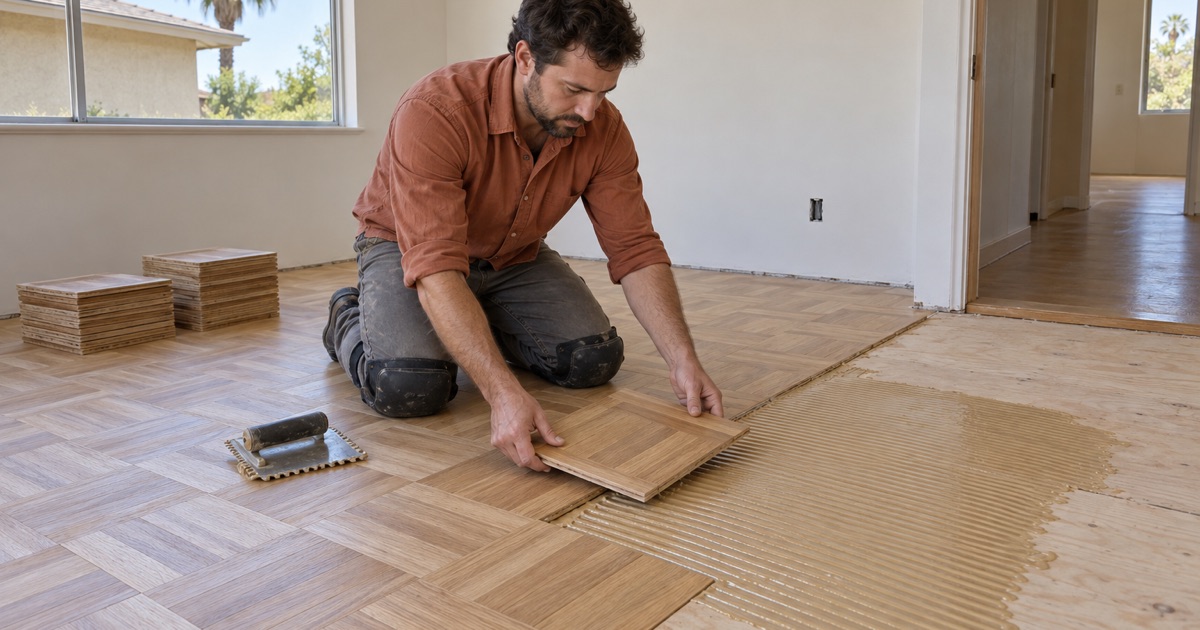
Loose tiles are lifted, the old adhesive is cleaned from both the tile back and the subfloor, and the tiles are reset in fresh adhesive with light weight until it cures. Where tongues or edges have broken, we replace those pieces rather than forcing them back in.
Finding Why the Parquet Failed
Adhesive rarely fails without a reason. Moisture coming up through a slab, a leak from a nearby bathroom or kitchen, or a subfloor that flexes between joists will lift parquet again after it is reglued. We take moisture meter readings and check the subfloor for movement before any tiles go back down.
On a raised foundation, that can mean fastening loose plywood or particle board from below. On a slab, it can mean waiting for a wet area to dry or choosing a moisture-tolerant adhesive system.
Replacing Damaged and Missing Parquet Blocks
Water stains, pet urine and burns often reach into a few blocks rather than the whole floor. We cut out the damaged pieces and fit replacements that match the wood species, block size and slat pattern. When an exact match is not sold anymore, salvaging tiles from a closet and moving the patch there is often the cleanest solution.
Some old parquet was sold as tiles held together by a paper or mesh backing, while other floors used loose individual slats. Knowing which one you have changes how replacement pieces are cut and set. We pull a damaged tile first to see its construction before ordering or salvaging anything.
Sanding and Refinishing Parquet Floors
Why Parquet Needs a Different Sanding Approach
On strip flooring, the sander runs with the grain. On parquet, the grain changes direction every few inches, so any aggressive cross-grain pass leaves visible scratches. We use lighter drum sander passes at an angle, then spend far more time with a multi-head or orbital sander to remove swirl and cross-grain marks.
Thin parquet tiles have limited wood above the adhesive layer. We check tile thickness at a threshold or vent before sanding, because a sand-through on parquet exposes glue and ruins the pattern in that area.
Stain and Finish Choices for Parquet
Parquet’s changing grain catches light differently block by block, which gives it depth even with a clear finish. Dark stains exaggerate any leftover sanding marks, so many owners choose a natural tone or a light stain. We test samples on your floor before committing to a color.
For the topcoat, waterborne polyurethane keeps oak parquet close to its natural color, while oil-modified finishes add amber warmth. Every finish we use complies with SCAQMD Rule 1113 and its 275 grams per liter wood coatings limit.
Screen and Recoat for Parquet in Good Shape
When the parquet is tight and the wear is only in the finish, a screen and recoat can restore it without sanding into the thin wood layer. This is often the best choice for parquet that has already been sanded once or twice.
We check for wax, silicone polish and oil soap residue before recoating, since those products stop a new coat from bonding. Floors polished for years sometimes need a chemical abrasion step instead of a standard screen, and we test a corner first so the whole room does not peel.
Installing New Parquet Flooring
Classic Parquet Patterns
Finger-block tiles, with several slats arranged in alternating squares, are the most familiar pattern. Basket weave pairs slats into woven squares, herringbone blocks set short rectangles in a zigzag, and Versailles panels combine borders and diagonal lattice work for a formal look.
Each pattern changes the labor involved. Finger-block tiles install fastest, while herringbone and Versailles require a precise center layout and many angled cuts at every wall and doorway.
Solid Parquet and Engineered Parquet Panels
Solid parquet blocks are glued directly to a prepared subfloor and sanded and finished on site. Engineered parquet panels have a hardwood wear layer over a stable core and are often prefinished, which shortens the job and adds stability over concrete.
Wear layer thickness decides how many times an engineered panel can be refinished later. We show you the specification for each product so you can weigh installation speed against long-term sanding life.
Preparing the Subfloor for Parquet
Parquet copies every dip and hump beneath it, so the subfloor must be flat, clean and dry. Over concrete we test moisture, including ASTM F2170 in-situ relative humidity testing where the adhesive maker calls for it, and grind or fill uneven areas. Over wood subfloors, we fasten loose panels and replace damaged sections before any adhesive is spread.
Parquet also needs acclimation and an expansion gap like any wood floor. Blocks are brought into the house before installation, and a perimeter gap is left under the baseboard or shoe molding so the whole field can move with seasonal humidity without pushing tiles up in the middle of the room.
Parquet in Older Baldwin Park Homes
Parquet Hidden Under Carpet
Pulling up carpet sometimes reveals parquet squares instead of oak strip. It may carry tack strip holes at the edges, pad stains or dried carpet adhesive. We assess whether the tiles are still bonded and thick enough to refinish before recommending restoration or replacement.
Parquet that sat under carpet for decades is often the best-preserved floor in the house, because the pad protected it from sun and foot traffic. Once the staples and perimeter damage are dealt with, many of these floors need only a careful sand and a fresh finish to look as they did when the house was built.
Black Mastic and Asbestos Testing
Older parquet was often set in black mastic, and similar adhesive sits under 9x9 floor tiles from the same era. Mastic is among the materials South Coast AQMD Rule 1403 treats as potentially asbestos-containing. We have old adhesive tested before it is scraped, ground or sanded, and condos and townhouses do not get the small-project exception that some houses do.
When testing comes back positive, the adhesive is handled under the rule’s procedures before any new floor goes down, which can add time to the project. When it comes back clear, we move straight to removal and subfloor preparation. Either way, you have a written result before any scraping starts.
Pre-1978 Homes and Lead-Safe Refinishing
Most Baldwin Park housing was built before 1980. When refinishing parquet in a pre-1978 home disturbs painted baseboards or old coatings, the EPA Renovation, Repair and Painting Rule applies. We set up containment, use HEPA vacuums and schedule cleanup and verification as part of the project.
In a busy household, we work the parquet room by room where the layout allows. A written schedule shows which rooms are closed on which days and when furniture and rugs can return, so a family does not have to leave home for the whole job.
- 20+ Years in Wood Floors
- Free Written Estimates
- Rental and Claim Documentation