
Baldwin Park Wood Flooring installs and refinishes hardwood stair treads in Baldwin Park, CA homes, with more than 20 years of experience turning worn or carpeted staircases into solid wood steps. We handle treads, risers, nosing and landings, and we price every staircase step by step.
Stairs are some of the most visible and hardest-working wood in a house. They are also detailed work: every step is measured, cut, fitted and finished on several faces, often by hand. That is why a staircase does not fit neatly into a square-foot flooring price, and why a quote that treats it that way tends to run short once work starts. Whether you want to reveal wood under old carpet, replace worn treads or match a new hardwood floor, we start by checking what the stairs are built from.
Converting Carpeted Stairs to Hardwood
What Is Under Stair Carpet
Pulling back the carpet on one step tells us most of what we need to know. Some staircases have oak treads that were carpeted later and can be refinished. Many were built with pine, particle board or plywood treads meant only to be covered, which cannot be stained to look like a finished hardwood step. We also look for tack strip, staples and old carpet adhesive, all of which leave holes and residue that have to be dealt with before the stairs are finished.
Refinishing Existing Hardwood Treads
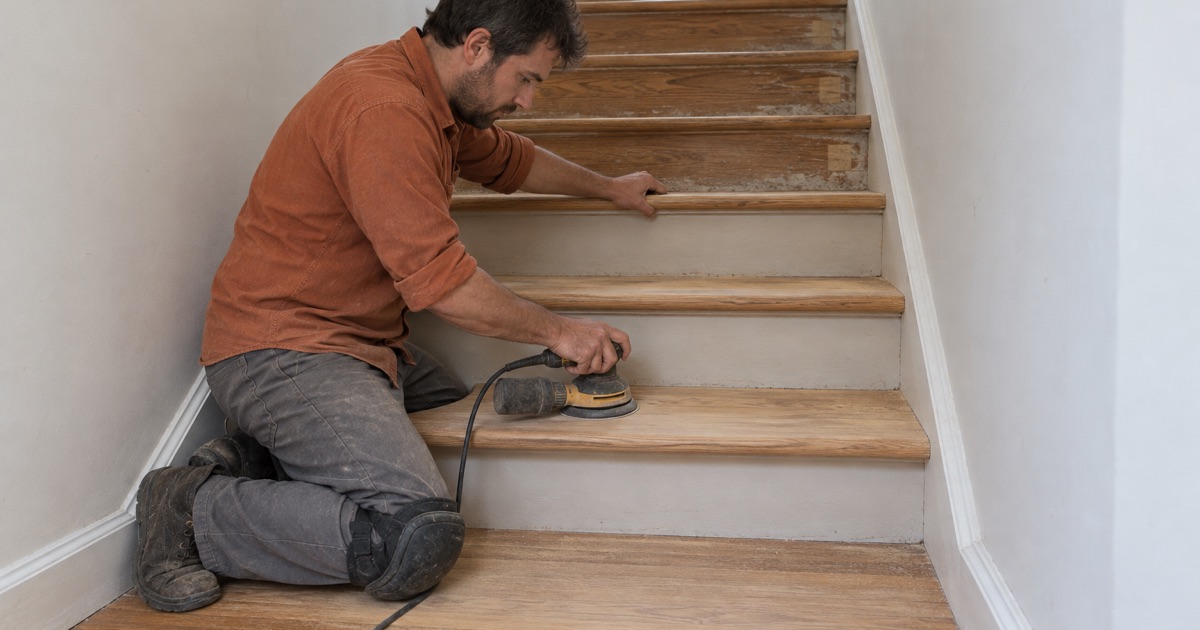
When the treads are real hardwood in sound condition, we remove staples and tack strip, fill fastener holes and hand-sand each tread, nosing and riser. Stairs cannot be sanded with a large drum sander, so edges, corners and returns are worked with smaller tools and scrapers. Stain and topcoats are then applied to match or complement the floor around them, with sheen levels chosen for grip as well as appearance.
Retrofit Treads and New Risers
If the existing treads are not meant to be seen, retrofit treads provide a solid hardwood surface without rebuilding the staircase. The old nosing is cut flush with the riser, and new hardwood treads are fastened and glued over the existing structure. New risers, often painted or stained to match, cover the vertical faces.
Retrofit treads keep the stair height consistent from step to step, which matters for safety. We measure every step before ordering, since older staircases are rarely perfectly uniform.
Stair Tread Materials and Styles
Species and Grain
Red oak and white oak are the most common stair tread species and match most hardwood floors. Hickory offers a harder surface for heavy traffic. Quartersawn and rift-cut treads have a straighter grain that suits modern stairs, while plainsawn treads show more grain pattern.
Solid treads are usually the better choice for stairs, because the nosing edge takes a beating and needs full-thickness wood to be sanded again later. Where a staircase meets an engineered floor, we choose a solid tread in a species and stain that blends with the engineered wear layer at the landing.
Stair Nosing and Landing Treads
Stair nosing is the rounded front edge of each tread. At the top of the stairs and on landings, a flush or overlap nosing piece joins the stairs to the hardwood floor. We align those pieces with the floor boards so the transition looks continuous rather than patched.
The landing is often where old stair jobs look worst, with a strip of mismatched wood or a carpet edge left behind. We plan the landing tread and the first row of floor boards together, so the grain direction and board widths line up when you look up or down the stairs.
Risers, Skirts and Returns
Risers can be stained to match the treads or painted white for contrast. Open-sided stairs need returns on the ends of each tread, and skirt boards along the wall cover the joints between treads and drywall. Each of those parts adds to the look and to the step-by-step price.
Stairs in Older Homes and Rentals
Painted Stairs in Pre-1978 Houses
Older staircases often have painted risers, stringers and skirt boards. In pre-1978 housing, sanding or scraping those surfaces falls under the EPA Renovation, Repair and Painting Rule. Most Baldwin Park homes were built before 1980, so we check the build year and plan lead-safe containment and cleanup when painted surfaces will be disturbed.
That work takes more setup than an ordinary stair refinish. Plastic sheeting encloses the staircase, HEPA vacuums collect dust as it is made and cleanup is verified before the containment comes down. We build that time into the schedule so the stairs are not rushed back into use.
Stairs in Rental Properties
California Civil Code 1941.1 lists floors, stairways and railings maintained in good repair among the conditions of a habitable rental. Loose treads, split nosing and worn carpet on stairs are common turnover repairs. We quote rental stairs with photos and a written scope the owner can keep with the unit’s records.
Refinishing Stairs With the Rest of the Floor
When stairs are refinished at the same time as the floors around them, the stain color and sheen match across both. We schedule stairs so the household still has a way up and down, often finishing every other step first when there is no second staircase.
In large and multigenerational households, that planning matters most for bedrooms upstairs. The written schedule shows which steps can be used on which days, how long each coat needs, and when the full staircase is ready for normal traffic again.
Caring for Hardwood Stairs
Finish and Traction
Stairs take concentrated wear at the front edge of each tread. A durable waterborne or oil-modified polyurethane protects that edge, and every finish we use meets SCAQMD Rule 1113 and its 275 grams per liter limit for wood coatings. Satin or matte sheen offers better grip than gloss.
Runners and Maintenance
A stair runner protects the center of each tread while showing wood at the edges, and it adds traction for children, older family members and pets. Regular dust mopping keeps grit from wearing the finish, and a screen and recoat renews worn treads before they wear through to bare wood.
- 20+ Years in Wood Floors
- Free Written Estimates
- Rental and Claim Documentation