
Baldwin Park Wood Flooring helps homeowners and landlords replace carpet with hardwood in Baldwin Park, CA, backed by more than 20 years of hands-on experience with what turns up once old carpet comes out. Some jobs reveal oak strip flooring that only needs repair and refinishing; others uncover particle board that has to be replaced before any wood goes down.
The difference between those two jobs is large, which is why we never quote a carpet-to-hardwood conversion from a room measurement alone. We pull back a corner of carpet first, often in more than one room, and write the estimate for the floor that is actually there. From tack strip and staples to subfloor, transitions and trim, the scope below covers what a complete conversion includes so nothing is left for a surprise change order.
What We Find Under Carpet
Oak Strip Flooring Waiting to Be Refinished
A large share of Baldwin Park’s housing was built in the 1950s, and many homes from that era were finished with oak strip flooring that was later covered with wall-to-wall carpet. Under the pad, those floors are often in better shape than owners expect, protected from sunlight and foot traffic for decades.
When we find oak strip, the conversion becomes a repair and refinishing job. That is typically the fastest and least expensive path to a wood floor, and it keeps the original wood that suits the house.
Plywood and Particle Board Subfloors
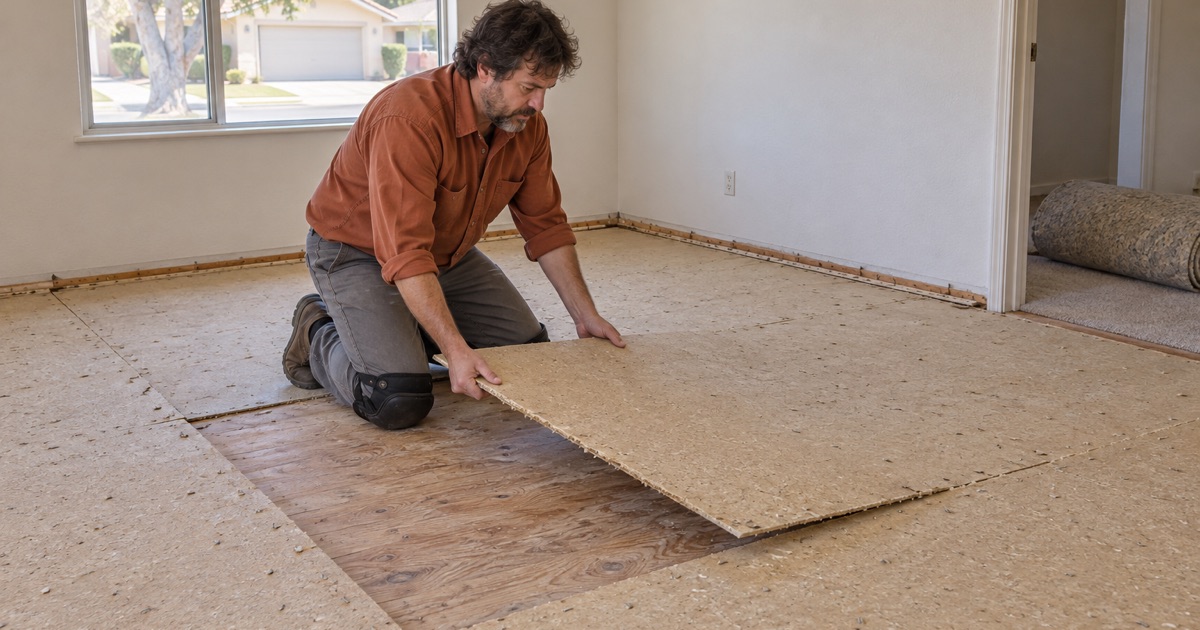
Houses and additions built for carpet often have plywood, OSB or particle board instead of finished wood. The 1980s added a large layer of carpet-era housing to the city, and those homes rarely hide wood floors. In those rooms, replacing carpet with hardwood means installing a new floor.
Particle board is the key detail. It crumbles around fasteners and swells when wet, and the National Wood Flooring Association’s nail-down guidelines exclude it as a base for wood flooring. We remove it and install plywood where a nail-down floor is planned.
Old Vinyl, Tile and Adhesive
Some carpet was laid over older sheet vinyl, linoleum or 9x9 floor tiles, sometimes set in black mastic. Those materials can contain asbestos. South Coast AQMD Rule 1403 requires an asbestos survey of all flooring layers before renovation, and condos and townhouses do not qualify for the exception available to some houses removing less than 100 square feet of intact material.
Carpet Removal and Surface Repair
Tack Strip Holes and Carpet Staples
Tack strip is nailed around the perimeter of carpeted rooms, and removing it leaves a row of holes and sometimes split board edges along every wall. Carpet staples leave pinholes across the room. We pull every staple and nail, fill small holes and replace edge boards that are too damaged to fill.
These repairs are part of our conversion scope, not an extra. Leaving them unrepaired, or hiding them under area rugs, is one of the most common shortcuts in carpet-to-wood work.
Pad Stains, Stuck Foam and Carpet Adhesive
Old carpet pad can leave waffle-pattern marks, and aging foam sometimes sticks to the floor. Carpet adhesive and paint overspray from past remodels may also be present. Most of this residue comes off during sanding, while stains that soaked deep into the wood may mean replacing a few boards.
Pet Stains Hidden Under Carpet
Pet accidents soak through carpet and pad into the wood below, leaving gray and black stains that are often only discovered when the carpet comes up. We identify those boards, replace those that will not sand clean and treat the subfloor if odor has reached it.
The number of stained boards is rarely clear until the carpet and pad are fully up, so our estimate prices board replacement per board. That keeps the quote honest in both directions: you pay for the boards that actually need replacing, not an allowance guessed from one corner.
Installing Hardwood Where Carpet Was
Choosing Solid or Engineered Hardwood
Over a plywood subfloor on a raised foundation, solid hardwood installed with flooring cleats or staples is a durable choice that can be refinished for decades. Over a concrete slab, engineered hardwood glued down after moisture testing is usually the better option. We help you compare species, widths and finishes for your household.
Subfloor Preparation
Once carpet and pad are out, we check the subfloor for soft spots, squeaks, water damage and flatness. Loose panels are fastened, rotted sections replaced and uneven areas corrected. On slabs, we test moisture before installing wood, using methods such as ASTM F2170 in-situ relative humidity testing when the product requires it.
Floor Height, Transitions and Trim
New hardwood often sits at a different height than the carpet it replaces. Where it meets tile, vinyl or another room, we install reducers, T-molding or thresholds. Along walls, shoe molding or quarter round covers the expansion gap, and doors may need trimming to clear the new floor.
Stairs, Rentals and Older Homes
Carpeted Stairs
Many stairs were built to be carpeted, so we check the treads under the runner before recommending refinishing or retrofit treads with new risers. Stairs are quoted by the tread, riser and nosing rather than folded into the floor price.
Rental Properties Between Tenants
Landlords often replace worn carpet with hardwood at turnover, since a refinished or new wood floor can be renewed later instead of replaced. We work to a leasing date and provide move-out photos and a written scope the owner can keep with deposit records.
Pre-1978 Homes
In houses built before 1978, sanding floors or disturbing painted baseboards during a conversion falls under the EPA Renovation, Repair and Painting Rule. We check the build year before scheduling any sanding and include lead-safe containment and cleanup in the plan when it applies.
For large households, a conversion can run room by room so bedrooms and a path to the kitchen stay usable. A written schedule shows when carpet comes out of each room, when the wood is finished and when furniture and rugs can return.
- 20+ Years in Wood Floors
- Free Written Estimates
- Rental and Claim Documentation