
Baldwin Park Wood Flooring refinishes engineered hardwood in Baldwin Park, CA homes, bringing more than 20 years of wood floor experience to a product that leaves far less room for error than solid wood. Every engineered job starts with one measurement: how much real hardwood sits above the core.
Engineered hardwood looks like solid wood from the top, but underneath the surface veneer is plywood or a composite core. That veneer, the wear layer, is all the wood there is to sand. Sand too deep and the core shows through, which no stain or finish can hide. Many floors that could have been renewed are ruined this way.
That is why we measure before promising anything. Depending on what we find, your floor gets a full sand and refinish, a screen and recoat, spot repairs, or an honest recommendation to replace the planks.
Understanding Your Engineered Floor
How Engineered Hardwood Is Built
Engineered flooring bonds a hardwood wear layer to a core made of plywood layers, high-density fiberboard or another composite. The cross-layered core resists the expansion and contraction that affect solid boards, which is why engineered floors are common over concrete slabs and in wide plank styles.
Federal TSCA Title VI rules define veneer bonded to a particleboard, fiberboard or veneer core as a laminated product, and the formaldehyde standards for composite wood reach many engineered floor cores. Labels mentioning TSCA Title VI or CARB Phase 2 on a flooring box refer to those standards.
Wear Layer Thickness
Wear layers vary widely from one product to another. A thick wear layer can be sanded more than once over the life of the floor, much like solid hardwood. A thin wear layer may not survive even one full sand and should only be recoated. Two floors that look identical can have completely different refinishing options.
We measure at a vent, threshold, stair nosing or other exposed edge. When the plank edge cannot be seen, the manufacturer’s specifications for the product can confirm it.
Prefinished Surfaces and Beveled Edges
Most engineered floors are prefinished, with factory coatings that are very hard and sometimes contain aluminum oxide. Many also have beveled or micro-beveled edges between planks. Both affect refinishing: tough factory finishes take longer to abrade, and sanding flat enough to remove bevels can consume a large part of a thin wear layer.
Refinishing Options for Engineered Hardwood
Screen and Recoat
A screen and recoat abrades the existing finish and applies a fresh coat without removing wood. It is the right choice for engineered floors with a dull, lightly scratched finish, and it preserves the wear layer for later. Factory finishes often need special abrasion or a bonding product so the new coat adheres.
We test adhesion in a closet or corner before recoating the whole floor. Wax, oil soaps and some floor polishes block adhesion and must be removed first, or the new finish can peel.
Full Sand and Refinish
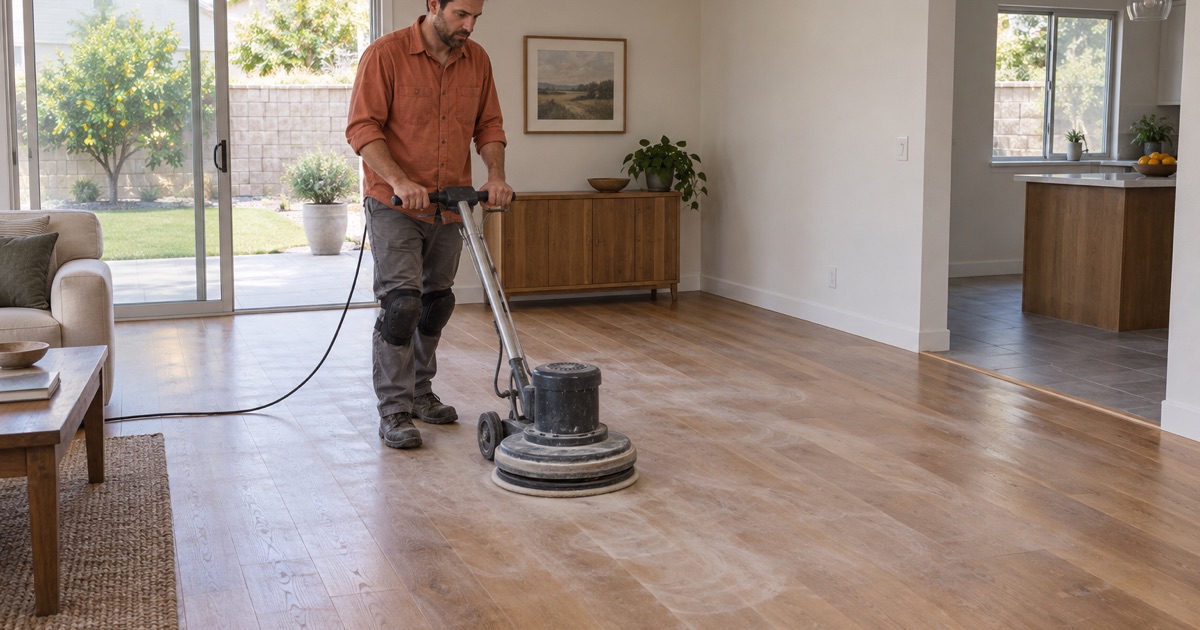
When the wear layer is thick enough and the floor has scratches into the wood, gray areas or a color you want to change, a full sand is possible. We sand with finer grits and lighter passes than we would use on solid hardwood, and we watch the depth closely around bevels, edges and uneven planks. After sanding, stain can be applied and the floor is sealed with topcoats that meet SCAQMD Rule 1113 and its 275 grams per liter wood coatings limit.
Spot Repairs and Plank Replacement
Isolated deep scratches, burns or water marks on engineered flooring are often best handled by replacing individual planks. Glue-down and nail-down planks are cut out carefully so neighbors are not damaged, and floating floors can sometimes be unclicked back to the damaged row. A recoat then blends the sheen.
Problems Specific to Engineered Floors
Veneer Delamination
When water reaches an engineered floor, the veneer can separate from its core, creating bubbles, lifting edges or a hollow feel. Delamination cannot be sanded or refinished away because the layers will not rebond. Those planks must be replaced, and the moisture source must be found first.
Sand-Through From a Previous Refinish
We are often called after a previous contractor sanded an engineered floor too aggressively. Patches of exposed core, usually along edges or in high spots, show up as lighter or darker areas that do not take finish. The fix is to replace the damaged planks, then recoat or refinish the surrounding area to blend.
Hollow Spots and Loose Planks
Glue-down engineered floors can develop hollow spots where adhesive failed or never fully bonded, often over an uneven slab. Small areas can be injected with adhesive. Loose planks along a wall may indicate the floor lacks an expansion gap. We correct those problems before any refinishing, so the new finish is not sitting on a moving floor.
Moisture Over Concrete Slabs
Many engineered floors are glued to concrete. When moisture rises through a slab, the floor can cup, the adhesive can fail and the veneer can delaminate. Before refinishing a damaged floor over concrete, we check moisture levels so the cause is addressed first.
Refinishing Engineered Floors in Baldwin Park Homes
Floors in Occupied Homes
A screen and recoat on engineered flooring is usually quicker and cleaner than a full sand, which makes it easier to schedule in a busy household. We still plan the work room by room, keep paths to kitchens and bathrooms open where possible, and give you a written schedule for foot traffic and furniture.
Rental Turnovers
Engineered floors in rental homes and condos often need renewal between tenants. A recoat can refresh a worn floor quickly for a leasing date, while plank replacement handles pet or water damage. Owners receive dated photos and a written scope to keep with their move-out records.
Choosing Between Refinishing and Replacement
When the wear layer is too thin, delamination is widespread or earlier sanding has exposed the core in many places, replacement is the better value. We show you what we measured and explain the options so the decision is based on the floor, not a sales pitch.
- 20+ Years in Wood Floors
- Free Written Estimates
- Rental and Claim Documentation